
The Guests Who Left and the Guest Who Stayed
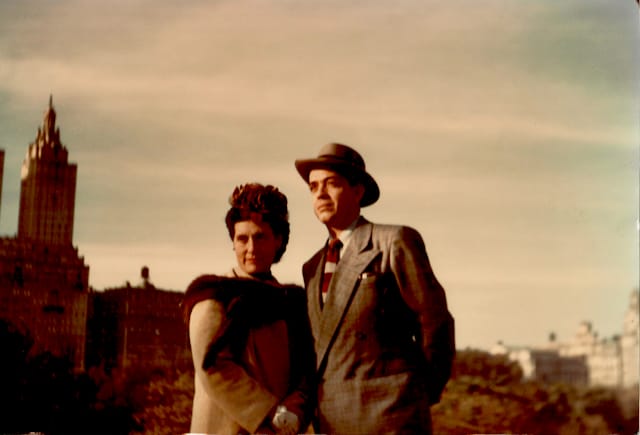
Queens County has the largest Ecuadorian population of any other county in the United States. A good chunk of that population lives in Sunnyside and Woodside.
And my abuela was positive that it was all because of her and her husband.
When my grandparents first moved into Sunnyside in the late 1930s, they would get stopped on the street and aggressively asked what language they were speaking. Most folks there had never heard Spanish spoken before, but beyond that, people were mostly worried that my grandparents might be speaking German – this was the late 1930s.
My abuelo was part of a small group of Ecuadorian businesspeople in New York City – they’d sponsor other Ecuadorians that wanted to move to the United States; pay their way, give them jobs and house them while they paid off their travel debt.
And my abuela’s rowhouse in Sunnyside was where a good amount of them first stayed. It wasn’t the nicest set-up – she said they would put a cot in the foyer for them where the stairs to the second floor began – but it was free, and the food and company was familiar to these young immigrants, so it felt as close to home as it could.
When it was time for them to move out, these new New Yorkers would almost always find a place close by in the only neighborhoods they knew - Sunnyside and Woodside. Once settled, that same process would repeat itself with them, now at their own homes, with their own cots, with their own new New Yorkers.
All of the Ecuadorian immigrants that stayed at my abuela’s house in Sunnyside were temporary residents of 50th Street.
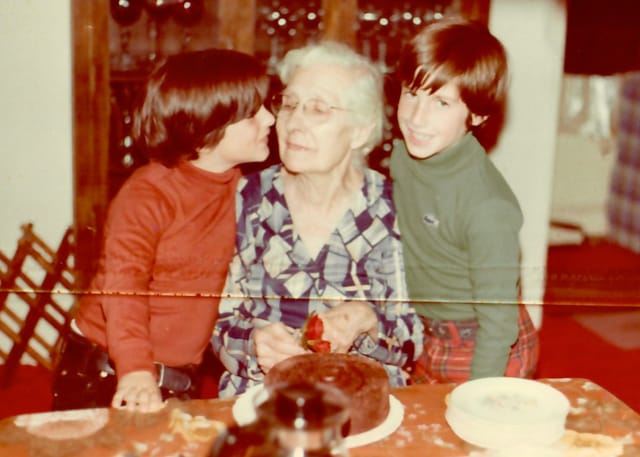
But there was one – a Venezuelan woman – who was invited into their home for a short stay sometime in the mid-1940s and didn’t leave until she passed away on February 27th, 1988 at the Willard Scott approved age of 101.
Her name was Henrietta Perez. Some called her Queta. My brother, sister and I called her Titi.
My abuela first met Titi on the 7 Train, then called the IRT Flushing Line, sometime in the mid-1940s.
My abuela (Abi, we called her) was coming home from her job - she worked as the Notions Lady at Bloomingdale’s in Manhattan. Deep in the basement, she sat in a large circular desk, her drawers filled with buttons of every variety, every size, every style.
If you lost a button, if you broke a button, if you needed a button, you came to see the Notions Lady. If she didn’t match it exactly, she would come damn close.
So, there’s Abi, riding the IRT home from Manhattan after a day of matching buttons. Across from her was a tiny lady – maybe 4’9”, maybe 75 pounds – surrounded by an amount of luggage she didn’t seem capable of carrying.
It was an odd sight, and it made Abi curious.
The small woman’s eyes seemed like they were red from crying, and her thin hands were clasped together. She desperately mumbled prayers in Spanish under her breath, like George Bailey on the bridge, aching for a power greater than her to save her.
Abi was worried for this woman she didn’t know, this woman she had never seen before this moment.
She decided she wouldn’t get off the train until this woman did, until it seemed like she was on her way to where she was supposed to be.
And so, the IRT passed 40th Street/Lowery, 46th Street/Bliss and Abi’s own stop of 52nd Street/Lincoln.
The two of them sat across from each other all the way to the end of the line – Flushing/Main Street. The red-eyed women didn’t budge.
The moment the doors closed, and the train began its elevated trip back to Manhattan, Abi stood up and sat down next to her.
In Spanish, she asked if she was okay, and the woman responded with a gush of relief, so thankful to be hearing words she understood in this place that she did not.
Abi asked her why she was where she was – crying on the IRT Flushing Line, seemingly lost.
The woman introduced herself as Henrietta Perez from Venezuela.
She had paid a service back home to handle her travel to the United States, to help her with everything she would need to get started. An apartment. A job. A bank account. And most importantly, an escort waiting for her at the piers off Battery Park to take her to all those wonderful new things.
All she had to do was give them all her money and they would set everything up for her in New York City.
It was a con.
When she disembarked from her ship and was processed at Ellis Island, she was taken with all the others to the southern tip of Manhattan and set free upon the city.
But no one was waiting for her.
She stood there for hours, not sure what to do, hoping to hear a language she could understand.
It started to get dark, and it felt safer to be near people, so she followed them as they walked away from the piers and eventually found herself on the subway.
That was yesterday. She had been riding the train for 24 hours.
Henrietta Perez, born in 1887, was already in her 50s when she and Abi met. Abi was twenty-plus years her younger and felt obliged to help her.
And so, in approximately 1945, Henrietta Perez – Queta to some, Titi to us – walked through the doors of 39-64 50th Street in Sunnyside, Queens, and there she stayed until 1988.
It should be noted that my abuelo – Abo, we called him – he really didn’t like Titi. Like, he REALLY didn’t like her. My cloudy 1970s memories involved them constantly bickering like bad sitcom adversaries.
Titi was fiercely loyal to Abi, and knowing what I now know about Abo’s mistresses, I can only imagine that this had more than a little something to do with her feelings towards him.
Eventually Abo had had it – he wanted her out, so he devised a plan to marry her off.
At this point Titi was in her 60s and rarely, if ever, left the house. How could she ever meet anyone? Abo realized he had to play matchmaker and bring this hypothetical suitor to their door himself.
He even put up a dowry – not much, but a little reward to whomever could rid him of this turbulent and seemingly endless houseguest.
Word came down that a friend of a friend of a friend was interested. And so, negotiations began. They all had diner together: Abi, Abo, Titi and this potential spouse.
Titi was charmed by the man, and the man was charmed by the dowry.
With all parties satisfied, Titi was married at City Hall a few months later, and soon the couple were on their way up to Niagara Falls for their honeymoon.
Back in Sunnyside, Abo was thrilled with himself and his plotting. Everything would be better from this day forward. Everything would be golden.
And then, five days later, the phone rang.
Abi picked it up and listened. Abo sat up in his recliner in the next room and tensed. He could hear the weeping spilling out through the phone receiver.
It was Titi. Between the tears and the shuddery breaths, she explained that she hadn’t seen her new husband since the day they arrived.
He had checked them in and set her up in their hotel room when he realized that he forgot something back in the car. He’d be right back, he said.
That was five days ago.
Titi stayed in the room, thinking he would come back, hoping he would come back, but he never did. And now it was the end of their stay, and someone had to pay the bill.
She had no money. She had no car. She had no husband.
Abi and Abo got in their car and drove up to Niagara Falls where Abo reluctantly paid the outstanding bill for the hotel and gathered Titi and her belongings.
The ride back to Queens was silent and seething. Titi ashamed. Abi consoling. And Abo plotting revenge on a man that he slowly realized he would never be able to find.
Titi’s marriage was brief, but it was just long enough for her new husband to empty her bank account – and that was on top of the dowery.
There was no more talk of Titi ever leaving the house on 50th Street.
And while it’s true that bad luck followed Titi from Venezuela to Ellis Island to Niagara Falls, it’s also true that good luck found her on the IRT Flushing Line.
It saw her crying, it took her in, and it gave her a home and a family that loved her until she left us on February 27th, 1988.
If you enjoyed this piece and want to support the work, please do so HERE.
Copyright @ 2026 by Alex R. Johnson